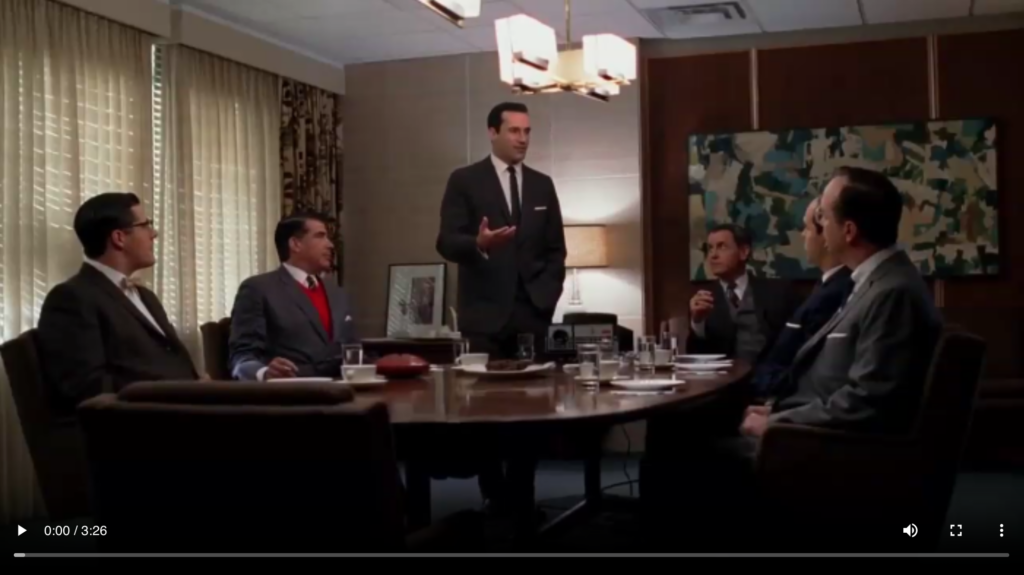
The other day, I wrote about a scene in the show Mad Men.
That scene illustrates some really useful presenting skills, so I wanted to call them out here. If you clicked through to the video the other day, you’ve probably already seen these, but in case not…
- He starts his story with “my first job” — time-shifting phrases (“my first job,” “a couple years ago,” “once upon a time”) tend to relax people and briefly draw attention to the speaker.
- He includes a few tangential details (“old,” “Greek,” “Teddy,” etc). Small details (names, places, colors) start the audience painting a picture in their heads, so they can imagine what you’re talking about. The details are not there to convey information, they are there to start the picture-painting process in your audience’s heads, so you don’t need a lot of details, just a few.
- He speaks slowly and pauses between words. His audience uses this time to paint a picture in their heads — if he spoke too quickly, or used a lot of filler words (ahh, emm, etc), the audience would have no time to paint pictures, and his speech would be boring.
One more thing: Notice that he gets his audience’s attention first, and then he starts using his slides. Remember that you almost always, always, compete with your slides for attention.
Oh, and notice that when he starts using his slides, he starts talking even slower. He knows that if he throws too much data at his audience, they’ll absorb nothing.
Here’s a link to the video in case you want to watch it again…