
The other day, recent podcast guest and list member Wes Wheless (hi Wes!) challenged those of us on his own email list to represent an idea visually.
I accepted the challenge, and figured I would try to visually represent that moment my friend Jeff buttressed my faith that all would be okay even after my backpack fell down the ravine (here’s a link to that newsletter), a moment which is uncannily similar to the moment that a client decides to purchase your services.
Here’s what that visualization looked like:
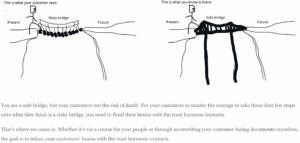
I’ll be the first to admit that my drawing skills leave something to be desired. But I decided that this is a fairly accurate depiction of that moment and how it applies to my business.
What does this have to do with your own presentations and client-facing communications?
You see a strong bridge, but your audience/client thinks the bridge is risky and feels fear, so they choose to stay in the present instead, which means they don’t implement your idea or purchase your service.
Your job in your presentations and client-facing communications is to bolster your audience’s/client’s confidence so they take those first few steps into the future.
Now to see if I can clean up those drawings so they don’t look like they were done by a three-year-old scrawling on a placemat at Denny’s. 😉